
The real shock was seeing Spring again.
The last time we saw each other—the only time we saw each other—was nine years ago, in Spain. I was still married, still in my twenties. She was still a rumor until that trip, the girlfriend of my good friend Logan. They were traveling in Ireland. I was living in France. We made plans to meet up in Spain, and during that trip we shared one of the greatest days of my life. A hike through the Alhambra, dinner of wine and cheese and bread on a plaza overlooking the city of Granada as, below us, two hundred thousand people roared their support of the Spanish national soccer team.

Me, Logan and Spring—Granada, Spain, 2006
Since that trip, Logan and Spring have moved to Mexico, broken up, moved back to the States, found their way back to each other, fell back in love, and now live in Tucson where they own a home and, less than a year ago, became the parents of two beautiful twin girls.
When Spring came out and hugged me that first morning I couldn’t think of anything to say except, “Been awhile.”

Spring and I playing chess in Spain, 2006.
There’s a kind of sadistic delight older people take in reminding young people that they, too, will age. Having grown up with my grandparents, I considered aging to be a good career move. You get old, you retire, you spend the day telling stories to your grandkids and having cocktail parties at night. My grandparents remain the most fun people I’ve ever met.
The part I never anticipated was that, as I got older, my friends would get older too. That they would get jobs, have children, and settle into lives you couldn’t have imagined when you were in school together. In the fourteen years Logan and I have known each other I’ve watched him grow from a grinning 19 year-old skater who dabbled in poetry to an internationally touring performance artist, teacher, and activist with a deep spiritual connection to the land he lives on, and the idea that everything he can change, and everything the kids he teaches can change, begins with a relationship to the land.

Logan Phillips in his Tucson neighborhood, 2015.
Logan and I have always been voracious travelers. We’ve both lived abroad (he in Mexico, me in France). We’ve both embraced nomadic existences for most of our lives, occasionally crossing paths in far flung points on the map. Now here we were on the back porch of a house he owned and had every intention of raising his family in. He motioned inside with his hand, referring to both his partner and his daughters. “I don’t want to do anything but work in my garden and spend time with my girls. That’s what’s most important to me now.”
For Logan, life now is all about this kind of tender care. His major concerns—raising children, gardening, running a youth poetry organization, teaching in schools—all share the common thread of helping living things grow with care and attention. In his garden, he takes me through an introduction to permaculture, a word he uses with a wink.
“It’s not like this is something new,” he says. “People have been using these techniques for centuries. We’ve just forgotten most of it in the last hundred years.”
A garden in the desert of the southwestern United States is a dicey proposition to begin with. The sun is merciless, water is scarce. Yet Logan has managed to take his garden completely off the city’s water grid, primarily by using rainwater caught off his roof, which collects in a few pots around the house, and one very large water tank that he uses to irrigate several parts of the garden.

The water tank. Gravity is used as the water’s primary delivery mechanism.
But rain doesn’t just hit the roof, so Logan dug ditches throughout the property to manage the flow of water during the worst storms of the year. And for the times of year when the rain isn’t falling, there are old methods of keeping the plants alive.
Perhaps the most unique method—at least to  anyone outside of the southwestern U.S. or northern Mexico, is the use of ollas. Ollas are ceramic pots that can be used as slow release watering systems inside of larger pots. What Logan has done—and what has been done for centuries—is to place the olla inside of a larger pot so that the lid is still exposed. Then he pours water into the olla, and the soil leeches the water out through the clay in the pot. Keeping a lid on the olla also prevents water from evaporating too fast, a major concern in this climate.
The idea, Logan tells me, is to get the land back to green a little bit at a time. If he can make these plants grow this year, he can make some more grow next year. There’s no better storage vessel for water, he reminds me, than the soil itself.

Logan uses sunflowers as trellises for climbing bean sprouts.
But for Logan, this idea of permaculture has a flaw. “I think there’s too much focus on the land and not enough on people.”
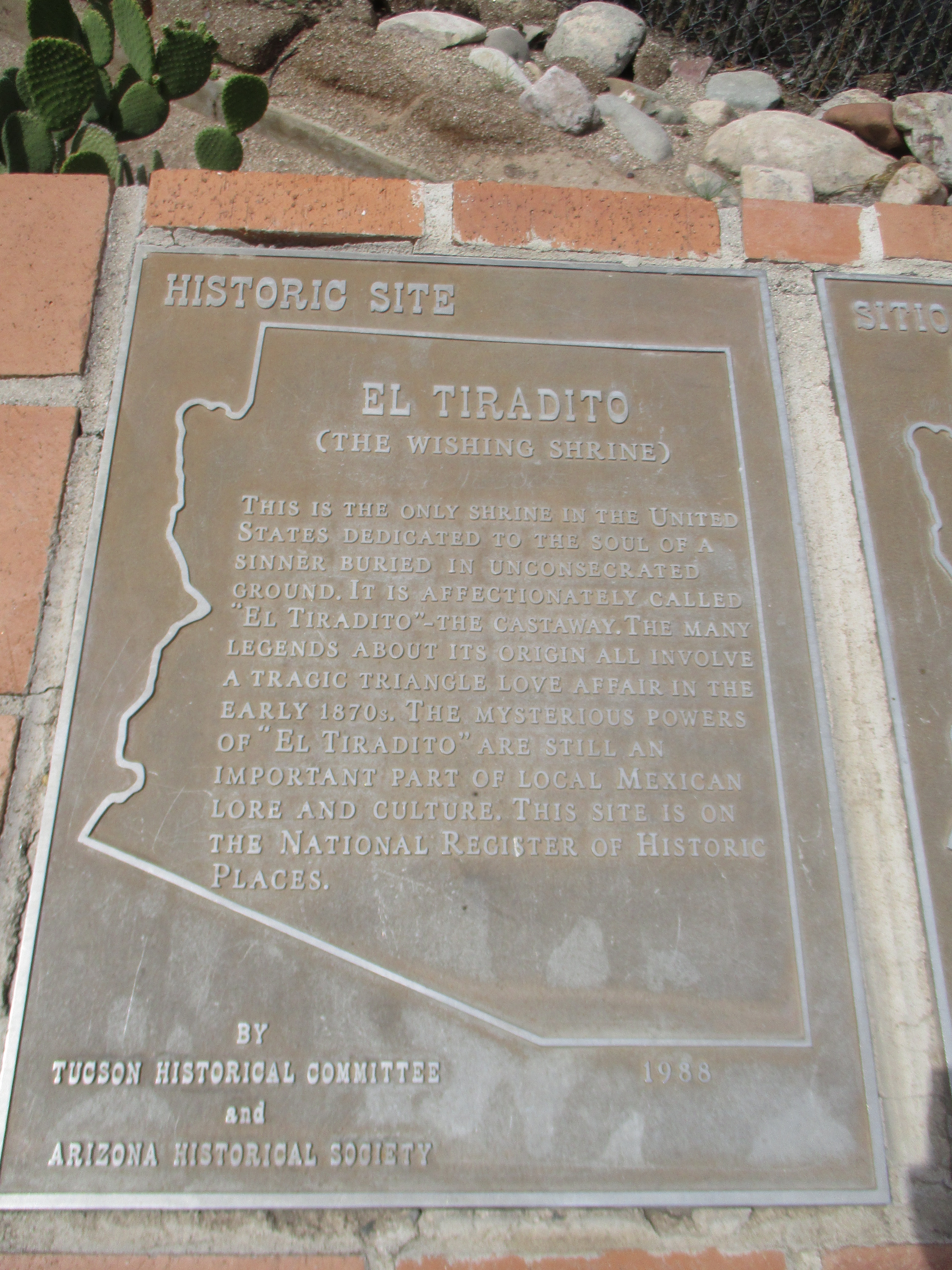
We are walking through his neighborhood, the oldest one in Tucson, to see the shrine of El Tiradito. Roughly translated as “the castaway,” this is reportedly the only shrine in the country dedicated to a sinner buried in unconsecrated ground. The buried soul was reportedly one part of a love triangle, and whether it was the woman involved or one of the men she loved depends on which version of the story you read. Regardless of the shrine’s origins, it has become a symbol of the neighborhood of Tucson Viejo. In part because of the garlanded flowers and votive candles that surround it, and the prayers written on paper and slid into openings in the stone wall. More importantly, however, this shrine has become symbolic because its very existence is the reason the neighborhood exists today.

El Tiradito shrine.
In the early 1970’s, the city of Tucson began construction on a massive project that would have plowed under the oldest part of the city to make room for a convention center and a freeway. The first phase, which cleared the way for the convention center, was completed, but the neighborhood held on to what was left by getting the shrine of El Tiradito listed on the National Register of Historic Places. As buildings on the register cannot be torn down, the city had to abandon its freeway plans, and the neighborhood managed to live on.
When we get to the shrine, Logan immediately sets about picking up candles that have fallen over and stacking them against the far wall. I join him.
“A lot of people think some places are too holy to touch,” he explains. “But holy things need just as much care as anything else. Maybe more.”
He invites me to leave a prayer in the wall, and I do. I tear a sheet of paper from my notebook and write a prayer for my mother and stick it in the wall. It’s not lost on me that the last time I saw Logan, and the last time I saw Spring, my mother was still alive.

Prayers left in the crevices of the wall at El Tiradito.
We walk the neighborhood for a while longer. Logan tells me about the plans for his youth poetry workshop, Spoken Futures. Almost by accident, the group has become a torch bearer in the fight to keep Mexican-American studies alive at the high school level in Tucson. This is important, because in 2010 the state of Arizona banned Ethnic Studies classes in all public schools. The decision, particularly because it seemed to specifically target the Tucson Unified School District—which has a very high number of Latino students—was seen as racially motivated. This perspective was upheld recently when a federal appeals court ruled that a lawsuit against the law could move forward.
This is not the first law to generate accusations of racism in the state of Arizona. In 2010, the state also passed a law called SB 1070, which requires law enforcement to determine a person’s immigration status if there is “reasonable suspicion” the person might be an illegal immigrant. Despite accusations of racial profiling (the law is known locally as the “papers, please” law), SB 1070 remains on the books.
For many of the kids Logan teaches, these laws feed into the sense that there is a new southwest, and that they are not welcome in it. They are the castaways in this new vision of America, and their isolation is a byproduct of the fear and paranoia that surround debates about immigration. Maybe it’s no accident, then, that Logan envisions the Spoken Futures program being headquartered next to the El Tiradito shrine. Symbolic of the forgotten and abandoned, the shrine still had the power to turn back powerful forces. More importantly, it exists as a reminder of what this city was in its past, and of who laid the groundwork to make much of the state what it is today.
Eventually, Logan and I wind our way back to the house. Spring is there, and the three of us sit in the kitchen, talking and reminiscing over a life that seems a million miles away on this bright day. Or maybe not. We all shared a moment in a sunblasted country nine years ago, and today we share another moment in another sunblasted country where these two old friends of mine have made their home, and make their stand.
A garden. A writing program. A family. These are people who grow things where people tell them nothing can grow. In the evening, we go to the back porch and watch the sun go down, the light playing on the leaves of the small trees in the garden. They look impossibly green.

To learn more about Spoken Futures, visit their website right here.
Logan’s website, for all of his multi-media work, is right here. His book, “Sonoran Strange,” is available on the site.
0 comment
I was reading the other day about how banning books marginalizes the groups whose struggles and strifes are addressed in the pages of fictions, giving them a character to latch onto with similarities and eventual successes that can give them hope. How it tells them, in not so many words, you don’t matter and I don’t care. I can only imagine how much worse that feeling is when it’s a law doing it and not an over-zealous group of over-protective, if not ignorant, community group at the local library.
I love how you can weave awareness into your travel stories.
Thanks, GG. I really appreciate it.