It’s the music of this country that brings me back. Even in the darkest of times—and we’ve had some dark ones recently—it draws me in and reminds me what I love about this place. I’ve needed that.
These last four years have felt like an extended exercise in hopeless exasperation, as we have come to terms with some of the ugliest parts of our legacy, as well as the fact that a great many of our fellow citizens would be just fine with abandoning the American experiment—and democracy altogether—in favor of a pathetic, racist conman, just because he tells them they should feel good about their ignorance.
One of the songs most frequently—and if you know the song, infuriatingly—invoked by these would-be populists (starting with Ronald Reagan) is Bruce Springsteen’s anthemic “Born in the U.S.A.” You’ve probably seen crowds singing along with the chorus and swept up in some kind of delirious patriotic fervor, even though the villains of the song would most likely be the very ones who are blasting it out of the speakers.
The song itself is the wounded cry of a crushed Vietnam veteran desperately trying to hold on in the face of a country that’s forgotten him. The schism between what the song is actually about and what people interpreted it as has been a thorn in Springsteen’s side for decades, and he’s frequently done concert performances where he slows the song and lets the brutal, dark tones come through, which you can also hear in a 1982 demo track of the song that still carries the haunted sound he used to such great effect on his album Nebraska.
Springsteen is one of our great songwriters, as well as one of our most prolific. In a career that’s spanned over half a century, he’s created an enviable music library that’s seen him go from struggling blue collar musician in the 70’s to a stadium-packing rock god in the 80’s, to a more introspective and quiet elder of the scene in the 90’s. More recently, he’s somehow managed to become all three: A hard-working, relentlessly creative artist who remains a champion of new music and young artists, while at the same time filling houses and doing energetic shows that last over three hours without a break. But it’s that songwriting that anchors his work. Among his greatest gifts is an ability to communicate nuanced experiences of American life that are so universal everyone finds something to love in it. His work has become a cornerstone in the pantheon of American music.
So it probably shouldn’t be a surprise that when Springsteen finally recorded an album of songs he hadn’t written himself, it would be for another prolific songwriter known for his deep commitment to American sounds: Pete Seeger.
* * *
In the wide range of career possibilities, from blazing star to unknown street performer to complete exile from the world of art, it’s hard to find anyone who covered more of the spectrum than Pete Seeger.
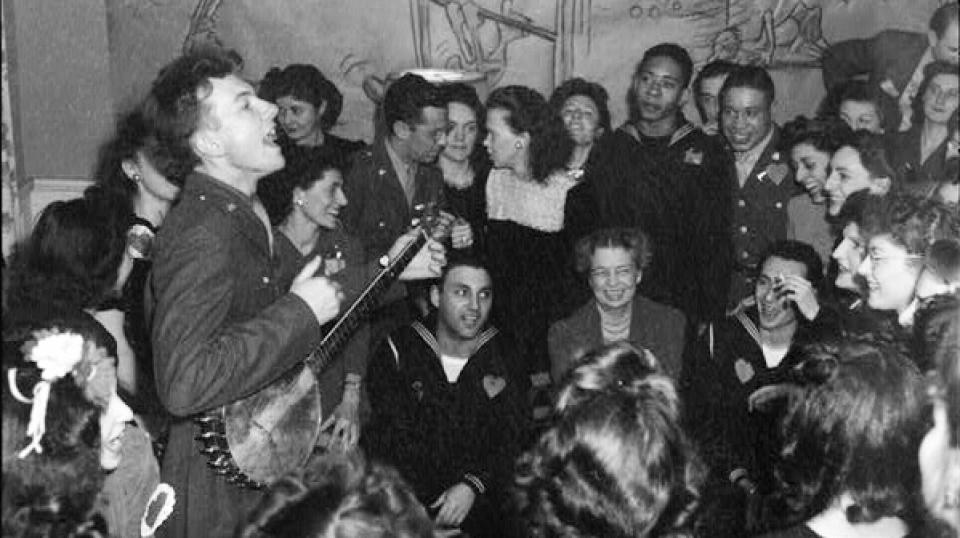
Seeger was a comet in the music scene in the late 40’s and early 50’s. After leaving the army, he formed a group called The Weavers, who specialized in reviving older folk and blues songs that had been overlooked or forgotten, from “On Top of Old Smokey” to “Wimoweh” to “Midnight Special.” But their biggest hit came in 1950 when they recorded Leadbelly’s classic “Goodnight Irene,” which sat at the top of the charts for an incredible 13 weeks.
And then came Joe McCarthy.
During the Red Scare (which should have more than a few eerie echoes today) Seeger was hauled before the House Un-American Activities Committee for being a communist. Rather than plead the fifth amendment, Seeger plead the first. He was convicted of contempt and, although his conviction was thrown out in 1961, he was largely blacklisted from major performances and national television for well over a decade.
But he kept performing, kept bringing songs to the people, kept pushing a vision of activism and peace. When he finally had a chance to go back on national television, after being booked on The Smothers Brothers Comedy Hour in 1968, he came out swinging. Rather than offer a taste of his old folk glory days, he launched into a fierce rendition of “Waist Deep In the Big Muddy” as an obvious Anti-Vietnam parable and a stinging rebuke of President Johnson at the height of the war. His performance is astonishing, angry and focused, and ultimately furious in the closing verses.
To say the performance was brave is an understatement. Career-wise, it was damn near suicidal. Having finally clawed his way back to the national stage, Seeger used the platform to try to push public opinion against the Vietnam War. But by then, Seeger had already seen his career knocked out from under him once, and he survived it. If this was the last time he was going to get back on the national stage, he was going to be the same performer he’d always been–a man of the people who could lightly entertain any audience, then turn around and take a flamethrower to the establishment (which he frequently did).
I’m sure the quietly uncompromising nature of Seeger’s principals appealed to Springsteen, as well as his commitment to social justice. But more than all of that, I think Springsteen saw (and still does see) Seeger as the kind of artist he’d most like to emulate. Someone who became an institution in American music by embodying all the rebellion that exists at its core.
* * *
That Springsteen would record songs made popular by Seeger seems logical. So does the way he recorded them, unless you look at how he’s always operated.
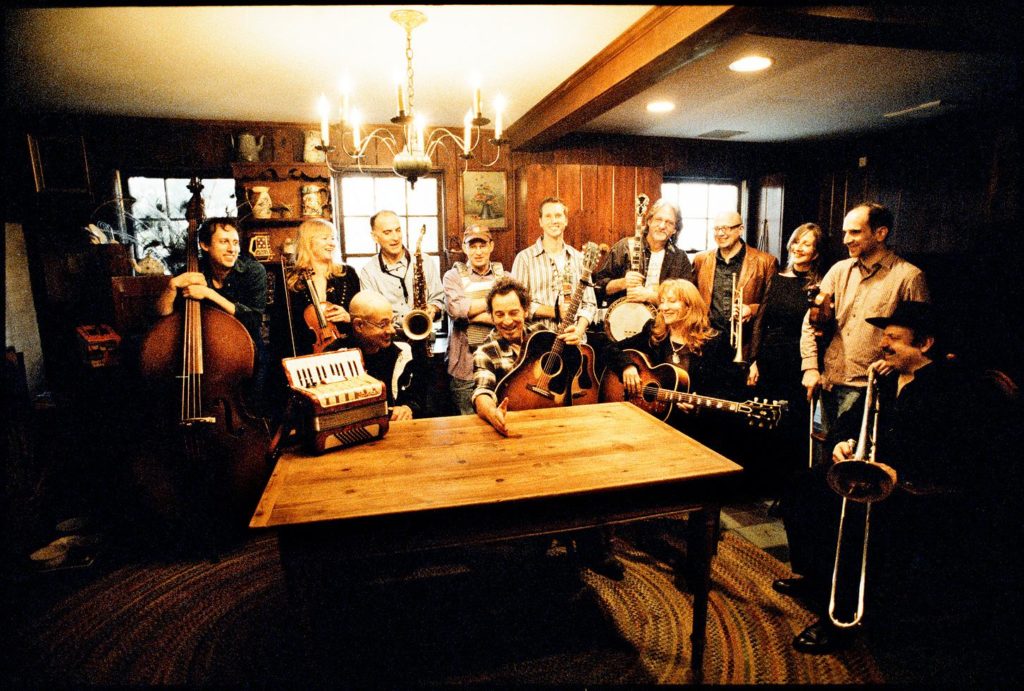
In the studio, Springsteen is a noted perfectionist. But for these recordings, that went out the window. He invited the whole Seeger Sessions Band out to his New Jersey farmhouse and recorded the album there, everyone talking and drinking, joking and staying loose, then busting out full throttle versions of the tunes with a round-the-campfire kind of freedom.
If it was a departure for Springsteen creatively, it was a calculated one. The nature of the recordings perfectly suits the material, which are largely two and three chord songs designed to be sung by the masses (Seeger would frequently say the next line of a song to the audiences during performances so that even those who didn’t know the lyrics could sing along). Throughout the album you can hear the energy this gives the band. You get the sense of the farmhouse they’re in shaking from the music while the neighbors stuff their pillows over their ears before finally giving up and coming over to the house to join the party.
Springsteen said of the sessions, “You get the sound of music not just being played. You get the sound of music being made.”
The resulting album was a big hit and mostly loved by critics. When the occasional bad review came in, it mostly had to do with the songs not adhering to a certain folk tradition.
For me, hearing the album for the first time, that was exactly the appeal. These were songs I’d heard my whole life, suddenly made new. And they were simple. The kind of songs that made me want to finally pick up a guitar and learn to play, which I did. I’m not saying this album made me become a musician (I use that term very, very loosely), but it definitely put a lot of wood on the fire.
Therefore, I could easily pick any song off the album, from the New Orleans jazz funeral styled rendition of “Oh Mary Don’t You Weep” to the soaring “Jacob’s Ladder.” But the one I keep coming back to is “Buffalo Gals.” It’s such a fun song that you could easily ignore its history, though I doubt Pete Seeger would have approved of that.
No, there’s no getting around it. “Buffalo Gals,” like a lot of great American music, was born in the minstrel shows.
* * *
That performers in blackface doing racially disparaging attempts at comedy should have been one of the most popular art forms in the country is repellent, though it shouldn’t be surprising, since you can still see echoes of it in more recent “we’re just having fun with this!” comedies (cough, cough, 30 Rock, cough).
But a song’s origin is not the story of the song itself, and Pete Seeger must have recognized this. While “Buffalo Gals” was undoubtedly born in an unapologetically racist setting, the song itself carries none of that burden. It’s a song about meeting dancing girls with torn stockings and partying the night away with them. It’s a celebration of good times and low company, the kind of thing that would be frowned upon by high society and bible-thumping clergymen who’d see it as the inevitable downfall of society.
In other words, a perfectly good rock and roll tune.
I like that this is how Springsteen approaches it. Sure, it’s folk music, but it’s on fire from the moment the horns jump in. What Springsteen and his band capture here is the sheer joyousness of the lyrics, which probably refer to sailors who just picked up their checks and are looking to spend every dime on the city’s dancing girls. It’s a party song, a celebration of a wild night with plenty of cash and no work tomorrow, and that’s exactly how it’s approached.
I’ve had nights like this, and I hope you have to. They stick in the memory. Up at all hours dancing in a rundown shack of a bar, singing along with the band as the drinks go around, the communal agreement of good, maybe slightly stupid fun that we’re all willing to pay for, in cash or in tomorrow’s hangover. The sort of small rebellions we allow ourselves to stay sane, and that we hope echo the larger rebellions that towering figures like Peter Seeger made into a way of life.
1 comment
Tell it, Nick! I love the knowledge and heart in all your posts. Thanks for this one, at the end of a long four years and a ragged nine months for our country.