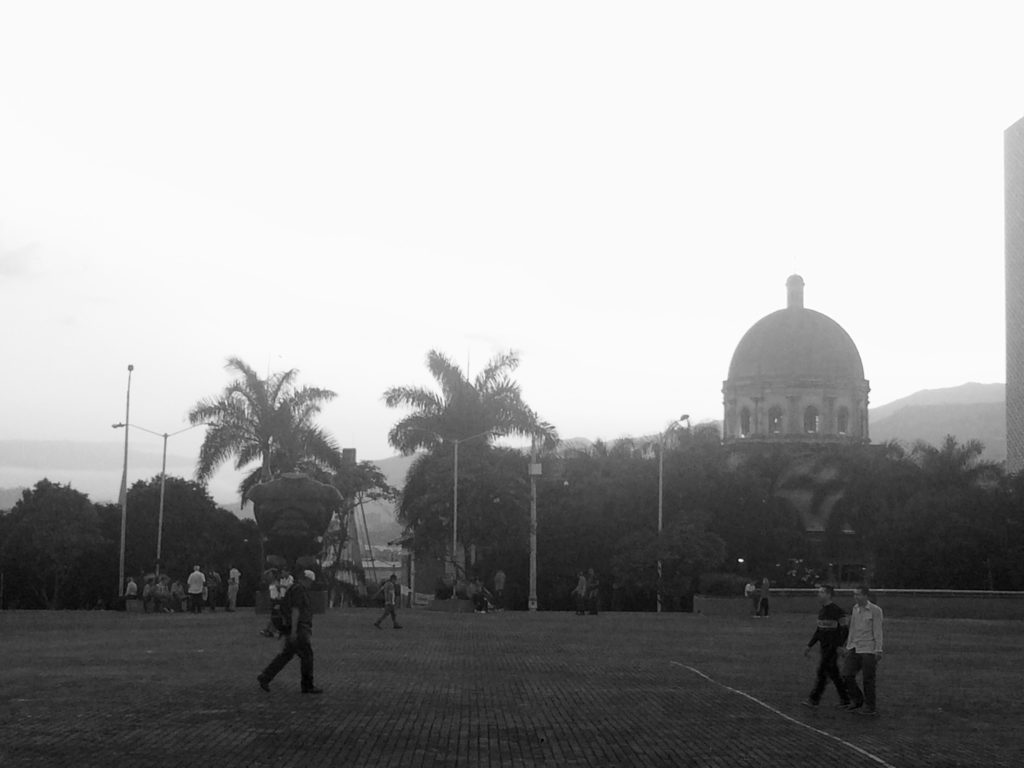
 “No one remembers this,” says Hernan Echavarría, my guide to the downtown section of Medellin, Colombia. We are standing underneath the city’s Metrorail, in the very spot where, he tells us, someone dropped a live grenade from the platform twenty years earlier. People were injured, he says, but no one was killed. It was simply another incident in what seemed an endless cycle of violence.
He goes on to describe the storming of the Palace of Justice in Bogota in November of 1985 by a militant group, and the subsequent siege by the Colombian military. Roughly 100 people were killed (the numbers are still controversial), including 11 justices of the Supreme Court. He describes the murder of presidential candidate Luis Carlos Galan and, later that same year, the bombing of Avianca flight 203, in which 110 people were killed.
Echavarría brings us back to the place we are. “In the middle of all of that, a hand grenade was nothing,” he says. “That’s why no one remembers.”
* * *
Like most of the days in Medellin, each of the days I spend there is perfect. The city’s fair temperatures and constant sunshine give plenty of traction to its claim as “The City of Eternal Spring.” Walking around, the attitude of the people seems as bright as the weather. From the “Park of Lights,” which was once a no-go zone even for police, to the cheerfully illegal shopping zone in the middle of a street that brazenly traffics in counterfeit goods, visitors hear “Welcome to Colombia.” And a moment later, “Welcome to Medellin.” A kid goes by me on roller skates shouting, “Hello! How are you!” in English as he races down the street.
It’s hard to reconcile that kind of relaxed atmosphere with the image of Medellin I grew up seeing, and that many people in the United States still imagine, thanks to the popularity of TV shows about Colombia’s drug wars. In the late 80’s and early 90’s, this was the most dangerous city on Earth. In 1991, over 6,000 people were murdered here. Car bombs exploded in the streets. There was a genuine question about whether or not the country could become a failed state. Medellin, it’s not hyperbole to say, was a city of fear.
Echavarría —a former college professor who now works for Real City Tours—talks about the city of his youth with difficulty, and there’s no sense that he’s putting this on for the tourists. He seems as amazed by the change as any of us, because he lived inside the entire arc. Eventually, he guides us to a park called San Antonio with two statues by the internationally renowned artist Fernando Botero. Medellin takes justifiable pride in the work of this native son, and there is a park in the city center dedicated entirely to his art.
What’s different about the sculpture Echavarría takes us to is that it is nearly destroyed. The sculpture is one of a bird, its core ripped apart, shards of metal sticking out dangerously in the center, their threatening edges ending in mid-air. This is the result of a bomb that detonated in the plaza, right under the statue, in 1995. Thirty people were killed in the bombing. Their names are listed below the body of the mangled bird.
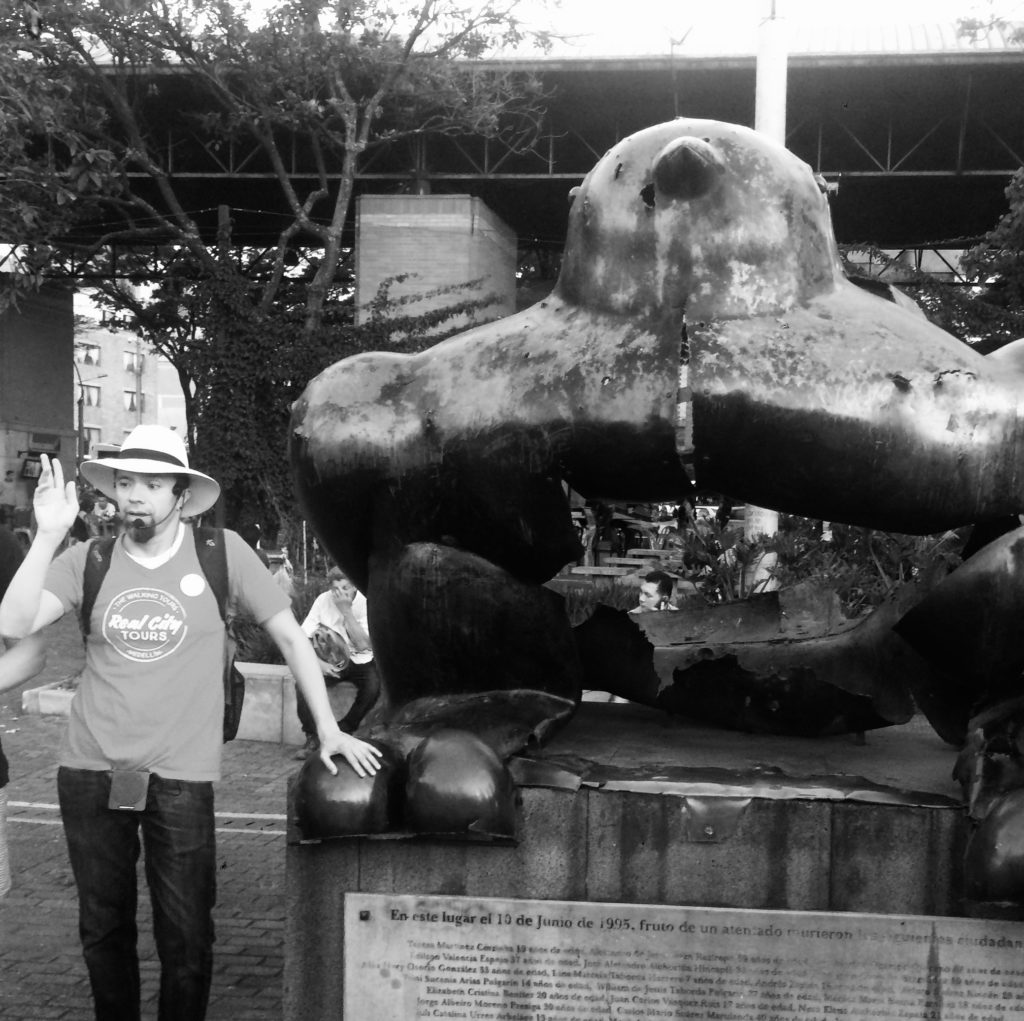 Hernan Echavarría stands next to the Botero statue that was mangled by the 1995 bombing.
A few feet away from the sculpture is another one. It is identical, and it is flawless. This, Echavarría tells us, is the story of his city during his lifetime. The bird with a hole in its center is the Medellin of his youth. The other, gloriously intact, is the city today.
It all sounds too good to be true, and the magnitude of Medellin’s turnaround is certain to invite skepticism. It is beyond question that things in the city are better, but how much better? How much of the appearance just for the benefit of outside eyes?
Even as Echavarría tells us about the optimism within the city, police drag a young man through the plaza, kicking and screaming, a vendor right behind them is pointing at the young man and calling him a thief. Moments later, Echavarría introduces an older man, a local who makes a speech thanking us for visiting his city and wishing us well.
The safest way to say it is this: Things are complicated.
* * *
Starting in 2002, under the leadership of President Alvaro Uribe, a relentless campaign by government forces greatly weakened the influence of three factions that held large swaths of territory in the country: Right-wing paramilitaries, left-wing guerilla groups (FARC and ELN being the most prominent) and the drug cartels. But while the gains have been met with approval by many in the country (Uribe’s popularity remains extremely high), widespread allegations of human rights abuses trailed the campaign, with particular criticism coming from Human Rights Watch and the United Nations. Allegations of extrajudicial killings led to the resignation of the commander of the National Army. One operation against FARC crossed over into Ecuador, nearly causing an outbreak of violence between the two nations.
Attempts at peace have been equally controversial. A peace deal aimed at ending the country’s 52-year war with FARC — a deal vocally opposed by former president Uribe — was surprisingly rejected in a national vote by the slimmest of margins (a difference of roughly 54,000 votes out of more than 13 million cast). President Juan Manuel Santos, the architect of the deal, was awarded the Nobel Peace Prize five days later, and the two sides made a second run at negotiations. Fifty changes later, the government bypassed the national vote altogether and sent the revised deal to the Colombian legislature, where it was approved. Negotiations with the other major left wing group, ELN, are in process at this moment.
It is a strange, optimistic time to be in Colombia. But with all of the violence so close to the memories of the people, the question of whether everything that has improved will stay improved is open to debate. As one hostel owner in Bogota put it, “Things are better, but this is still Colombia.”
* * *
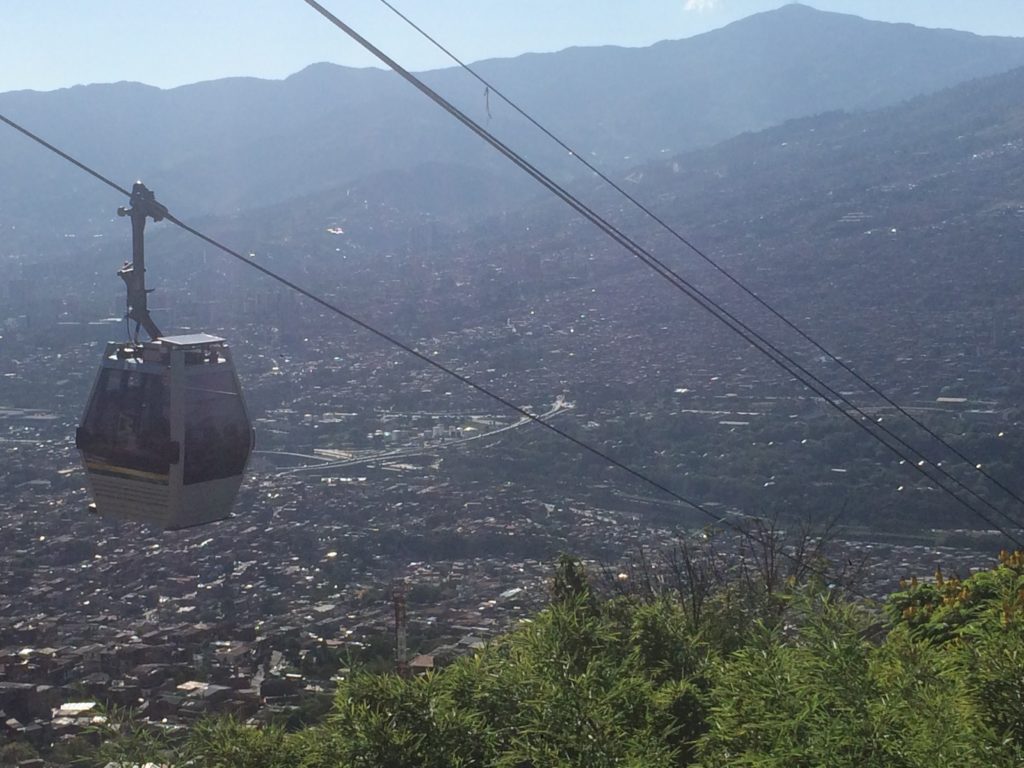 The Medellin Metrocable.
“They had to build that,” says Pedro, a resident of Armenia in the coffee region. “If they didn’t, the cartels would have run those places forever.”
He’s referring to the Metrocable, and to the neighborhoods it serves. A product of the new millennium, the Metrocable is an example of the innovative “social architecture” for which Medellin has been a pioneer, and consists of a line of cable cars that rise from the valley of Medellin into the hillside communities that surround it.
For years, these communities were ignored by the city. As a result, they became recruiting grounds for the cartels. Children would be brought in and groomed as lookouts, dealers, and sometimes assassins. In the absence of a police presence, gangs essentially ran the neighborhoods.
Where most cities would have done all they could to shut those communities out, Medellin went the other way. It started in the 80’s and 90’s with the construction of the Metrorail, the only rail-based mass transit system in the country, and a source of enormous pride to locals (as evidenced by the immaculate condition of the trains — not a scuff mark or a scratched window to be seen anywhere). Running from the city center to the outlying neighborhoods, the Metrorail drastically reduced commuting times for workers in the far north and far south of the city.
Then came the Metrocable, with the first line inaugurated in 2004. Ascending over 1300 feet to the neighborhood of Santo Domingo Savio, it has obliterated one of the major barriers between the city and the hillsides. Whereas in the past, someone from Santo Domingo Savio would have had to walk hundreds of steps down just to reach the Metrorail (not to mention the hundreds of steps back up), they can now ride the Metrocable and be on a train for the city center in about 15 minutes. A trip to the center that would have taken hours in the past can now be done in about 30 to 40 minutes.
An even more unique project was installed in Comuna 13—a 1,260 foot long electric escalator system, designed to get people up and down the hillsides more easily. The quicker commute time means greater access to city services and, theoretically, to better jobs, which brings more money back to the outlying neighborhoods.
How big an impact these services are having remains open to debate. A large uptick in the number of homicides in 2009 and 2010 created a great deal of skepticism about the projects’ long-term value (the murder rates in the city have steadily dropped since then). The massive Biblioteca España, standing next to the Metrocable station in Santo Domingo Savio, and a major point of pride for the city’s renewal, developed unexpected structural flaws in its facade (though the core seems to have remained in good condition). It is currently under repair.
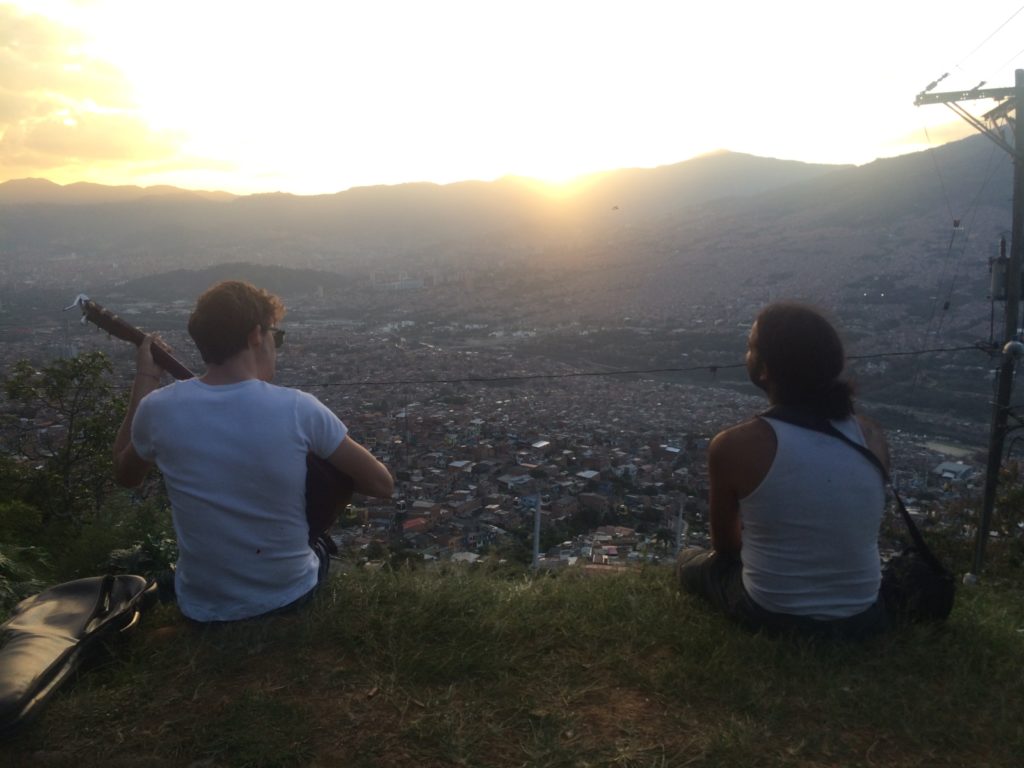
But despite setbacks along the way, the feeling of the Santo Domingo Savio neighborhood is extraordinarily positive. I visit on a Sunday, and the neighborhood is filled with families on walks. A huge playground overlooking the city rings with the sound of laughing children. Vendors sell arepas and hot dogs from portable stands. Bars and restaurants line a beautifully paved street. From a church, the sound of singing. Behind the church, a young couple kiss in the fading light of the evening. When my friends and I walk into a bar far from the most tourist-friendly part of the neighborhood, we are greeted enthusiastically by the bartender and several customers immediately move down to make room for us. Whatever the setbacks, whatever problems still remain, it is impossible to believe on first glance that this was once considered one of the most dangerous neighborhoods in the country.
There is a mood of hope. It’s a cautious optimism, to be sure. But cautious optimism is better than none at all. A decade ago, what I was seeing was considered impossible. But in Colombia, what is possible is a constantly changing thing.
As one chef in Santa Marta told me repeatedly, “En Colombia, todo es posible. Nada es seguro.”
In Colombia, everything is possible. Nothing is certain.
2 comments
Excellent piece. Concise and fascinating story on the changes in Columbia that neatly explains the country’s civil war and surprisingly positive current events.
Beautiful write up, Nick. I’d like to go to Central America someday, but I was thinking more toward Belize and Costa Rica. I’ll have to consider Colombia now.