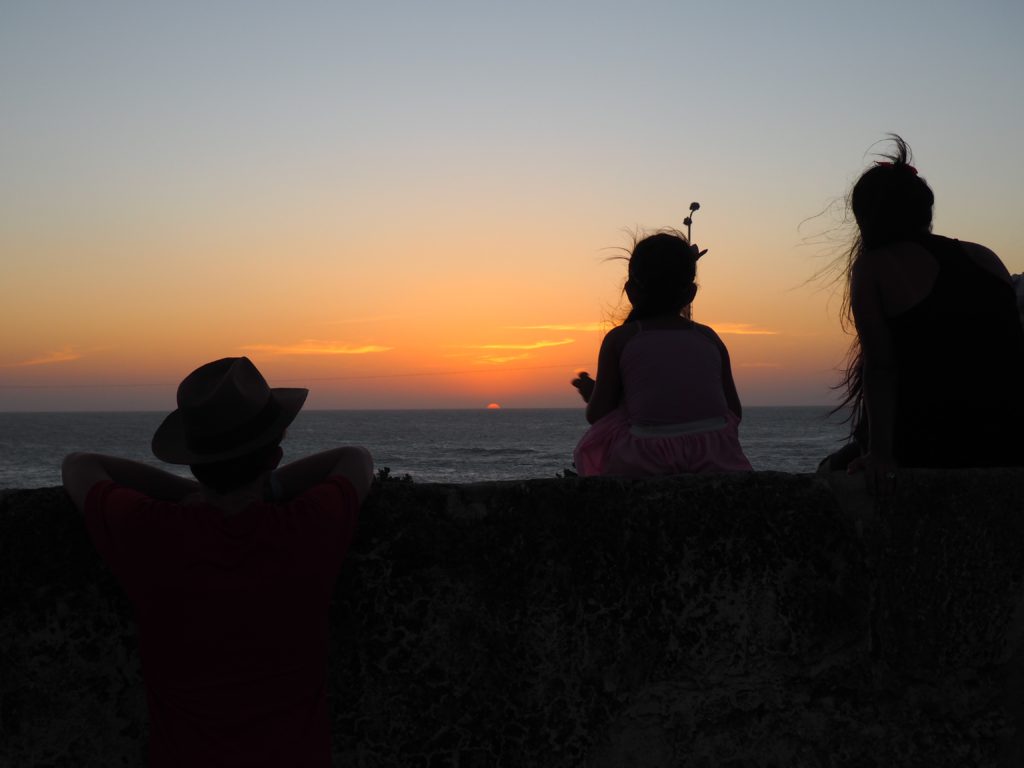
Welcome to South America.
It’s a treasure town, and it always has been: a large emerald door onto the continent. Convoys loaded with silver and gold and jewels mined by enslaved people in the mountains to the south would arrive in Cartagena, where they would be loaded onto galleons and shipped to Havana, and eventually to Spain, where they propped up the Spanish Empire until the flow of precious metals created so much inflation that the weight of the Spanish crown crushed the heads it sat upon.
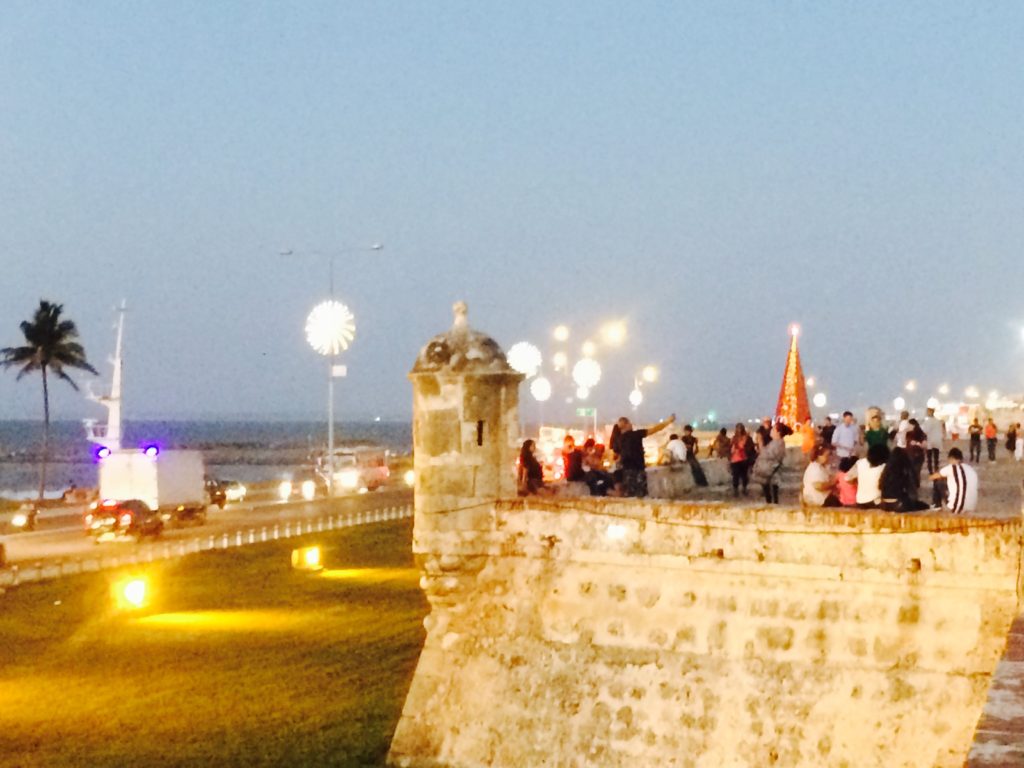
The wealth of the port made it an attractive target for pirates, whose raids were so consistently successful that engineers constructed walls around the city and heavy fortifications that would eventually prove as useless as the Hapsburg rulers who ran the show. But they look nice, and that’s the draw of the new gold rush. A series of walls, protecting a restored colonial city. The tourists are the silver train these days. Come see the relics of an empire, and the climate ain’t so bad either.
 It’s as good a place as any to make an arrival on this continent. I’m back in South America for the first time in two decades. Those two decades have seen seismic shifts in Colombia, and attempting to recount those changes inevitably leads to talk about the drug trade, which if you grew up in the 80’s/90’s, or if you’re looking at any TV show set in Colombia these days, seems to be the only part of Colombian history that ever occurred. It’s an ugly, violent slice of the Colombian story that the country is doing its best to move past. Meanwhile, Hollywood is busy making folk heroes out of the architects of much of that violence. (I’m looking at you, Netflix.)
Cartagena’s story is a long one, and much of the history that gets discussed here has to do with its colonial era. As a city, it’s been around for nearly 500 years. Like almost every old city in the Americas, it was built on top of an indigenous village. From its old walled heart to the gleaming towers of the Bocagrande section (which, like much of the newer construction in nearby Panama City, looks very similar to Miami), to the hastily constructed sections to the south designed for the rapidly expanding population, Cartagena de Indias has become the fifth largest city in Colombia. The economy revolves around tourism, with all the trappings that go with that: kitsch shops, late night clubs, hawkers selling tours. Plus, the added bonus (if you’re a dumb-looking gringo like myself) of being offered cocaine by random strangers at least once every block.
(A quick word on that: If you’re stupid enough to say yes to any random schmuck offering you cocaine on the street then you deserve whatever fate you get. At best, you’ll end up with a nose full of baking soda. You do not want to think about the worst case.)
But for all the trappings of a tourist town, Cartagena remains pretty laid back. Aside from getting wares hawked at you, it’s pretty hassle-free. It’s also easy to navigate and highly walkable. And if you’re off to the beach on the weekend, half the city is going to be making its way there with you.
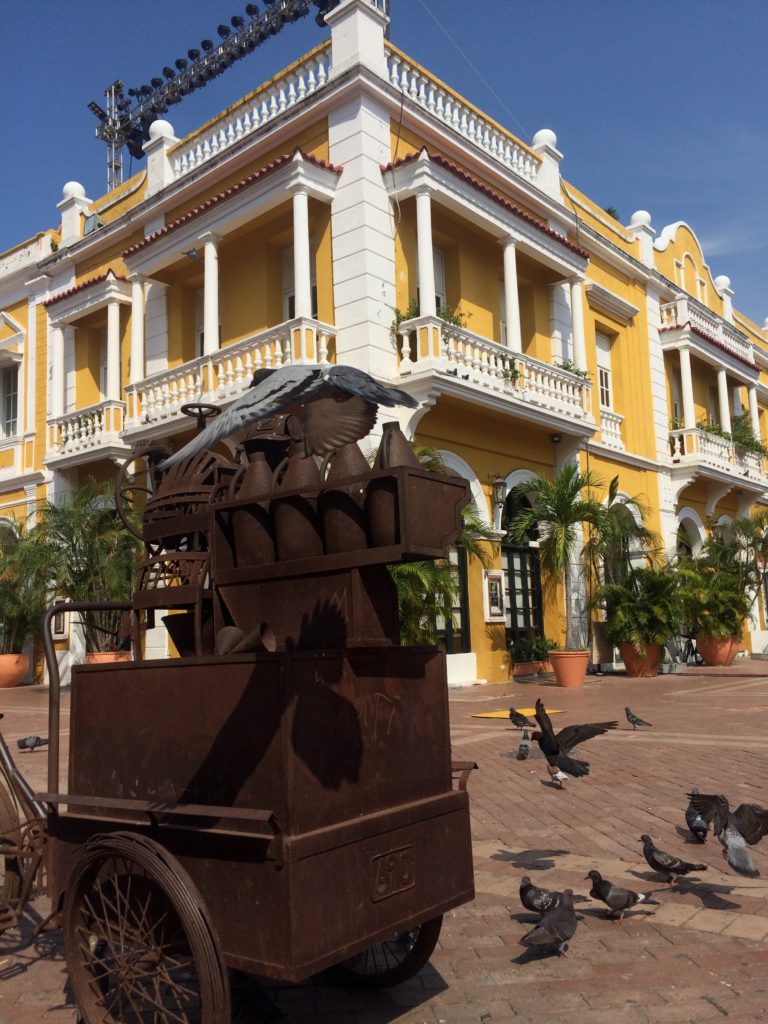 Pigeons gather in front of one of Cartagena’s old colonial buildings.
It’s also a big music town. The strong Afro-Caribbean influence in the region led to the formation of the country’s most distinctive musical style: Cumbia. In the 1950’s, artists like Lucho Bermúdez helped birth a movement of big-band Cumbia music that can be compared to the big-band swing era in the United States or the proliferation of Mambo orchestras in Cuba in the 50’s. Other forms like Vallenato (an extremely popular accordion-based music that originated in the northern valleys) and Salsa have a strong history in the city as well. (You can find a statue of local Salsa legend Joe Arroyo in the plaza dedicated to him on Carrera 10).
Street musicians are out in force here, and most of them are excellent. In the Plaza de la Santísma Trinidad in the Getsemani neighborhood, musicians take advantage of the foot traffic to launch regular performances. A couple blocks away, at the Bazurto Social Club, a converted house is home to music and dance seven nights a week, and much of the music is of the live variety.
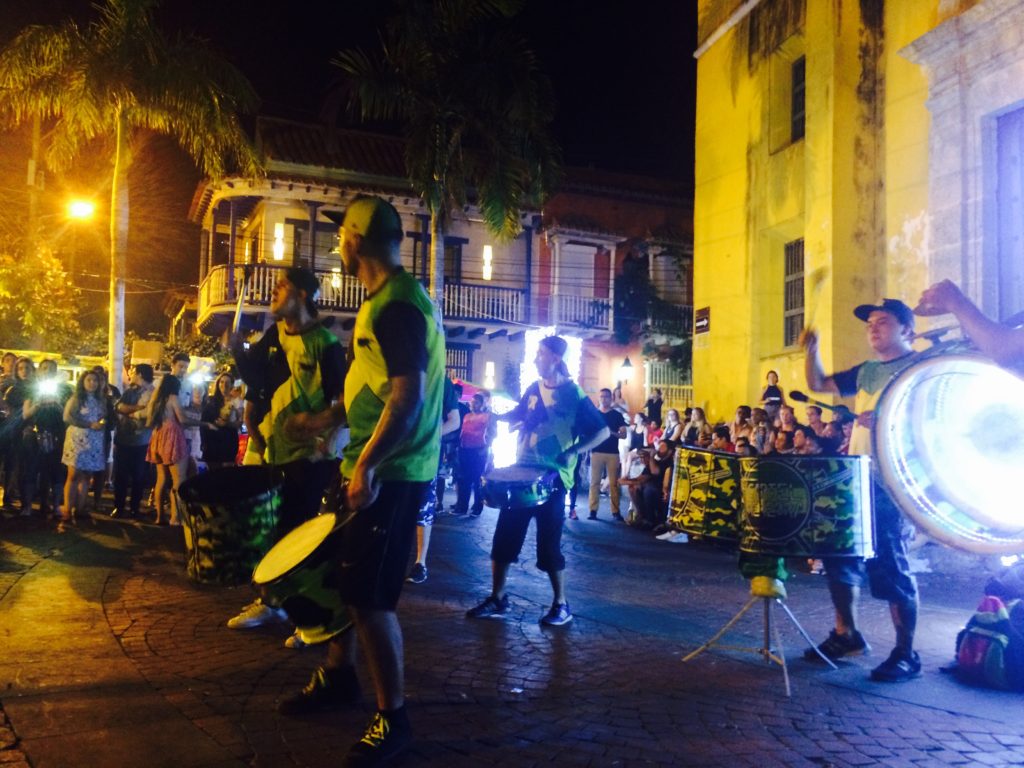 A drumline performs in the Plaza de la Santísma Trinidad.
The music was of particular interest to the other members of my traveling party. I’m going to be on the road in South America for the next few months, and at varying points I will be traveling with two friends. One is Sam Doores, a professional musician who has been making big waves with his band The Deslondes. The other is Christopher Romaguera, a Miami-born writer who, like me, is making an attempt to turn his creative pursuits into full-time employment. As a settling point, Cartagena provided us all with a solid anchorage. While it’s a town that leans heavily on tourists, many of those tourists come from South America. The result is a transient town that still expects you to have some working knowledge of Spanish. And if you don’t have it, give it a shot anyway. As in most countries, a little effort at the local language goes a long way.
If you want to get your Spanish in better working order (as we did), Cartagena is a good place to study. There are numerous schools in the area, but we went with the Medellin-based Toucan Spanish School, which has a few excellent teachers who provide private lessons from an office in the state bank building.
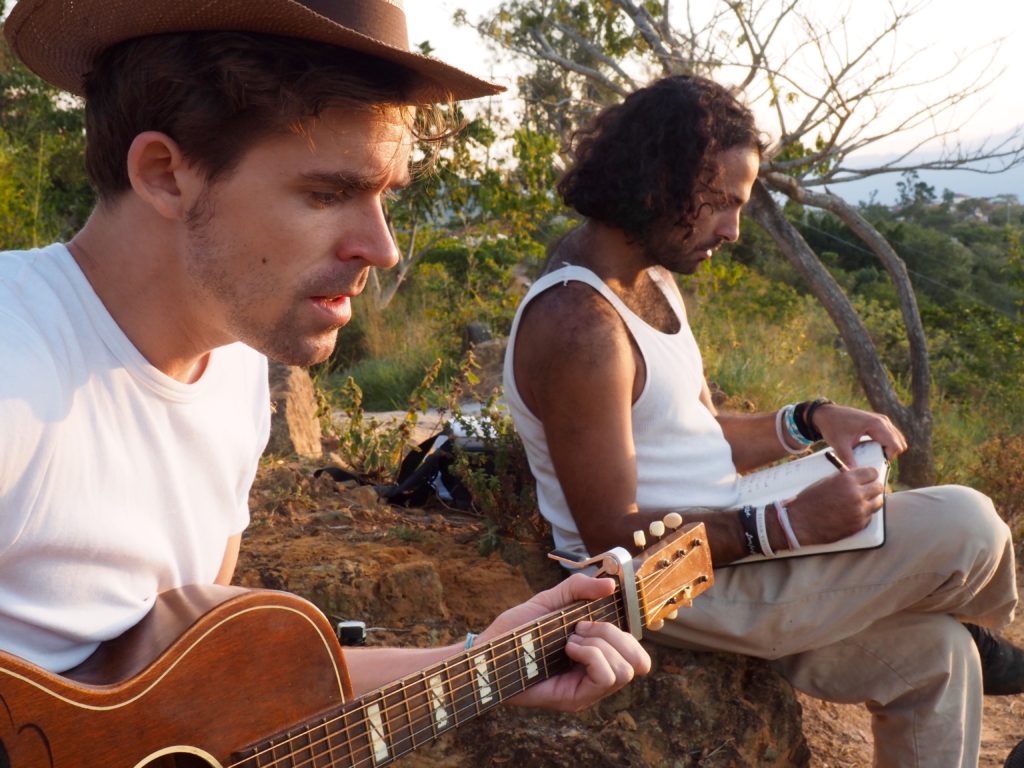 Sam Doores (L) and Christopher Romaguera (R), my traveling companions in Colombia.
In all, we spent a week in Cartagena, and many of the tourists in the area had plans to stay just as long, if not longer. The town makes a good base of operations for exploring the region. Hostels and hotels will usually allow you to store your bags if you want to take off to explore Parque Nacional Natural Tayrona or attempt the difficult and beautiful jungle trek to Ciudad Perdida. Or for day trips, it’s easy to skip over to Isla Tierrabomba or the lovely beach at Playa Blanca.
But it’s just as easy to fall into an easy stroll and wear a path down the neighborhood streets. Cartagena has always made a target for invaders, from corsairs to tourists. The walls that once kept out the former now keep in the latter. It’s a welcoming place in a welcoming country. It sits out there, a gem on the sea, and invites you to wonder what could exist beyond its confines.
Stand on the walls as the sun goes down and the moon comes up. You’re one of the invaders now, and you won’t be the last. Cartagena has held up so far, and I imagine it will find a way to thrive from whoever comes next.
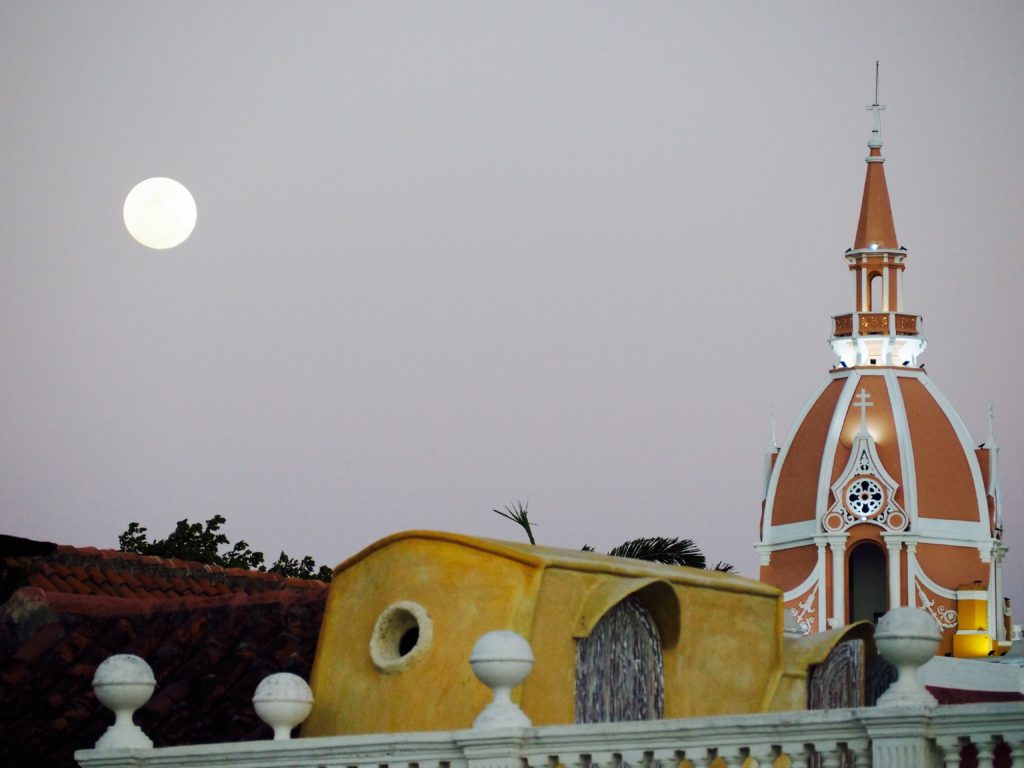
If you are interested in the music of Colombia’s Caribbean coast, here are a few examples from the artists previously mentioned.
Lucho Bermúdez and his orchestra performing the classic Cumbia, “Tolu”
https://www.youtube.com/watch?v=9GPw4-B7LMQ
Vallenato legend Carlos Vives performing “La Gota Fria”
Cartagena Salsa singer Joe Arroyo doing a live performance of “En Barranquilla me Quedo”
1 comment
Yes. Yes Nick. Keep it going amigo. I am there in my imagination through your writing. Gracias.