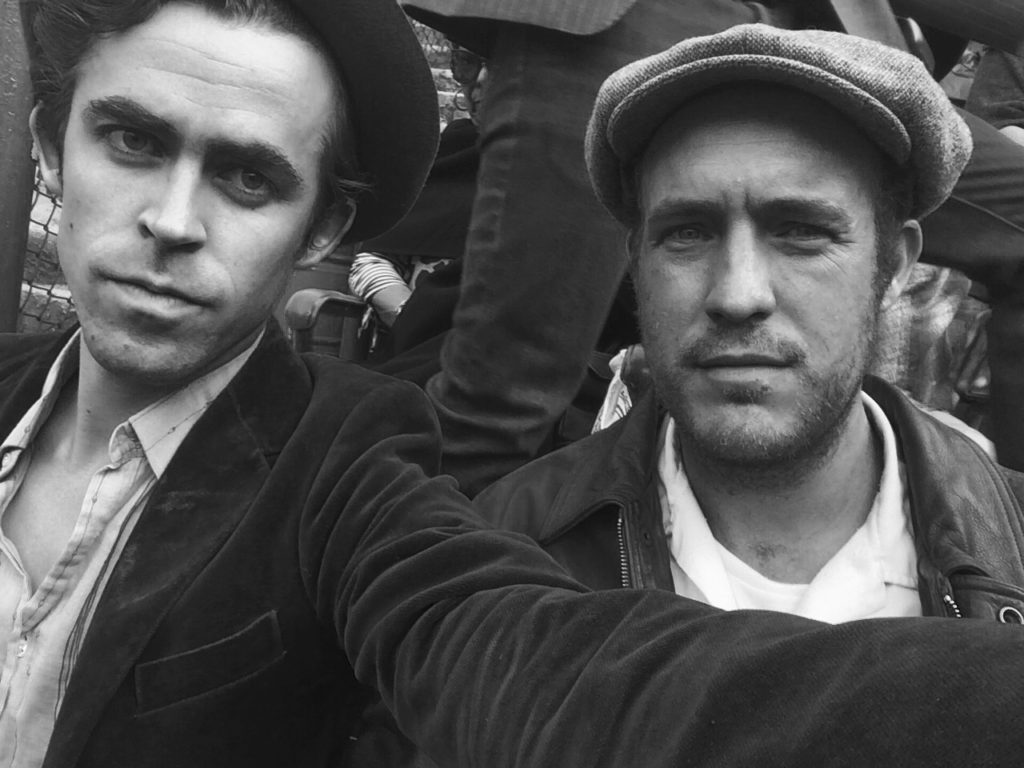
If we were going to be climbing an ancient Mesoamerican temple at sunrise to take in the view, we decided, then we damn sure better bring something of value to offer the gods. And if we were going to bring an offering, it only made sense that the offering should be good quality mezcal.
“We’re going to need a flask,” I told Sam. “I’m not going to risk dropping a glass bottle on the stone.” Littering the Pyramid of the Sun with broken glass because I couldn’t hang on to the bottle would, I felt, make for a poor offering. It would also be kind of the most American thing I could do.
Sam and I found a liquor store near our hostel in Coyoacan and purchased a bottle of mezcal recommended to us at our restaurant the night before. As well as a couple of oranges, because we are both vigilant about our vitamin intake.
“So tomorrow for the pyramids?” said Sam.
“Tomorrow,” I told him. Because that night we had a plan. We were going to hunt down a signless, supposedly secret mezcal bar called La Clandestina. Finding it would prove to be the single most difficult thing we did in three nights in the western hemisphere’s largest city.
* * *
I’ve always loved Mexico City. So much so that if I were to be exiled from my home country and told I would have to live outside its borders forever, Mexico City would be my first destination. It’s like a dozen cities crammed into one. In fact, it is a dozen (or more) cities crammed into one, with formerly independent municipalities like Coyoacan and San Angel swallowed up and made part of the metro area as the city continued to grow.
It’s been a haven for artists and expats, with everyone from Leon Trotsky to Luis Bunuel to Gabriel Garcia Marquez finding a home within its spacious confines. It has produced writers the caliber of Carlos Fuentes and Octavio Paz, painters such as Frida Kahlo and Diego Rivera and Jose Clemente Orozco, filmmakers like Oscar winners Alejandro Gonzalez Inarratu and Alfonso Cuaron. It’s a food town. It’s a music town. It has dazzling architecture and a great mass transit system. Like many cities in the western hemisphere, it has a staggering gap between its richest and poorest citizens, and a small middle class that struggles to hold it all together. And though the headlines often make it seem far worse than it is, it has a crime problem. A big one. Much of it fueled by the drug trade which brings a variety of narcotics, stimulants, hallucinogens, and various other illegal substances into the noses and mouths and veins of the gringos to the north, who continue to shake their heads at the rampant crime south of them as they lean forward to do another line.
It is also a city of neighborhoods. Some of them so rural it is shocking to realize you are still within the limits of a major city. Some of them crammed together and pressed into the surrounding hillsides. But of all the neighborhoods in Mexico City, my unquestioned favorite is Coyoacan, the longtime home of Frida Kahlo, and an oasis of calm in Mexico’s racing heart.
My traveling companion for this visit to the city was Sam Doores, singer/songwriter and driving force behind a fast rising band called The Deslondes, who Rolling Stone listed as one of the ten country artists you need to know. He’s also my roommate back in New Orleans. I met him at the airport and guided him to the Metro, unquestionably one of the best and cheapest local rail lines in the world. It covers a staggering amount of the metropolis and our one-way fare to Coyoacan ran about twenty-five cents, American.
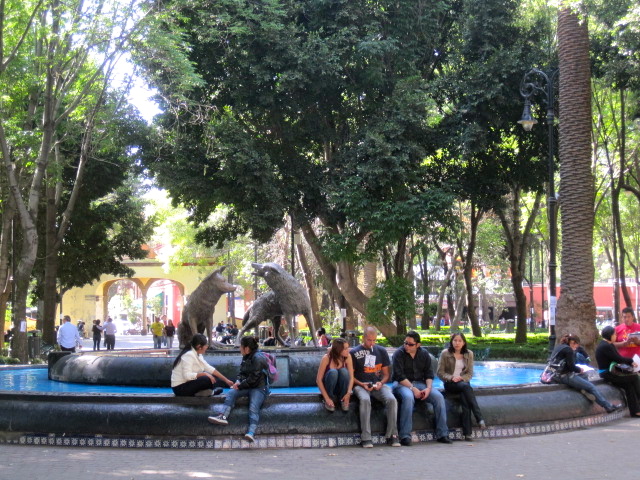
Locals relax around the coyote fountain in central Coyoacan.
Coyoacan means “Place of the Coyotes,” and a monument to the canines in question sits at the center of the main plaza. It’s a great place, day or night, for taking a stroll, sitting and reading a book, or people watching. And like most of Mexico City, it’s a great place to kiss someone. At least according to what I’ve seen. I’ve been to Paris, but Mexico City makes the Parisians feel positively Victorian. There seem to be couples kissing on every corner. I can’t imagine anyone would ever create a “makeouts per square foot” chart, but if they did, I’m sure Mexico City would leave Paris in the dust.
Coyoacan is also, like all of Mexico City, a great place to eat. Looking out over the fountain are several restaurants, and perhaps the best of these is Los Danzantes. I’m a big believer in creature comforts the day one arrives in a new country. One should try to settle in with a nice room and a nice meal, if possible. It’s a treat for yourself after a long trip, and it’s good way to set the tempo for the rest of your time.
Sam and I took our first meal at Los Danzantes. There are some very special meals where what you ate doesn’t seem to matter.  I can tell you that the meal at Los Danzantes that first night was one of the best I’ve ever had, but I’ll be damned if I can tell you exactly what I ate. And does it matter? When I recommend my favorite restaurants to people, the recommendation usually includes the words “trust me.” I can tell you there was impeccable service, that every bite of the food almost had us doubled over laughing the laughter of two people getting away with something, who can’t believe their luck that they should find themselves eating this well in a place this nice. When our waiter brought out the bottle of mezcal (with black lava salt and orange slices on the side), it wasn’t even a question as to whether we would be ordering any, as Los Danzantes isn’t just a restaurant. They are also distillers, championing one of the finest mezcals on the market (it is known in the States as Los Nahuales). They serve it in house, and sell bottles around the city.
Including the bottle we would later buy to take to Teotihuacan.
It was over two hours before we waddled out of the place. If I’d eaten any more they would have had to roll me out. It was the finest meal I had in Mexico City, and that’s saying something, because it is almost impossible to find bad food here. I told Sam as much as we went home, but I don’t think he heard me. He’d been in the city all of three hours and had already been treated to one of the best meals of his life. Nothing could have spoiled his view of the city after that.
* * *

I have been told by people in the know that Singapore is the world’s capital for street food. Me, I’m putting my money on Mexico City. There are stands everywhere. In markets. On roadsides. All of them turning out a lot of tacos and tortas and passing them your way for the price of a halfway-decent cup of coffee in the States.
There are also a lot of them  in the old colonial heart of the city, and that’s convenient, because you don’t want to waste a lot of time when you are walking around the heart of Mexico City. You want to look at buildings, wander in and out of museums, eat something good, and then keep walking.
At the heart of the city is the Palacio de Bellas Artes, an extraordinarily beautiful building housing a number of murals by Diego Rivera and David Alfaro Siqueiros. With its golden dome, marble facade, and crystal interior roof, it seems somehow escaped from a Russian novel and placed like a gem in the center of a ring here, in Mexico City.
The architecture in the historical center is stunning, and there constantly seems to be more of it. Temples are being excavated, and they sit there below street level next to colonial buildings that loom up from every direction. The historic center is highly walkable, although saving some of your energy is advisable if you want to go off in search of hidden mezcal bars at night.
* * *
La Clandestina, we heard over and over again, was the place. A hole in the wall without a sign. Difficult to find, but worth it. As it turned out, “difficult” wasn’t the half of it. We found three different addresses listed for the place. The cab driver didn’t know where it was. Everyone who claimed to know where it was turned out to be wrong. An hour into our search, we ran into two women looking for the same place. They followed us for half an hour and then gave up. Each point in a direction led us to a new part of the city. The three different locations on Sam’s phone led to us covering a solid four miles or so. We walked by it, we would later learn, at least twice. And it wasn’t until after midnight, as we were piling into a cab to give up the fight that I noticed a design on the side of a building that looked like an agave plant.
I said, “That has to be it.”
We jumped out of the cab, passing the cabbie a 50 peso note for stopping for us, and walked into the small entrance.
“La Clandestina?” we asked at the front. A man who was framed by a couple dozen large plastic water bottles, all of them containing mezcal, all of them feeding into a Rube Goldberg array of tubes that led to various taps, nodded. He did not smile. We informed him we’d been looking for the place for a couple of hours. His expression didn’t change.
“Si, es clandestino,” he told us, and if there had been subtitles underneath him, they would have clearly added, you dumb asses.
Chilly reception aside, La Clandestina is pretty much everything you would hope for in a place of its kind. A series of small tables, dim lighting, and a list of some of the finest mezcal to be found on the planet. With each glass, they bring a few orange slices. This is not the lime at the end of a tequila shot, because you do not shoot good mezcal. You sip it slowly like good Scotch, of which it shares some of the same, smoky qualities.
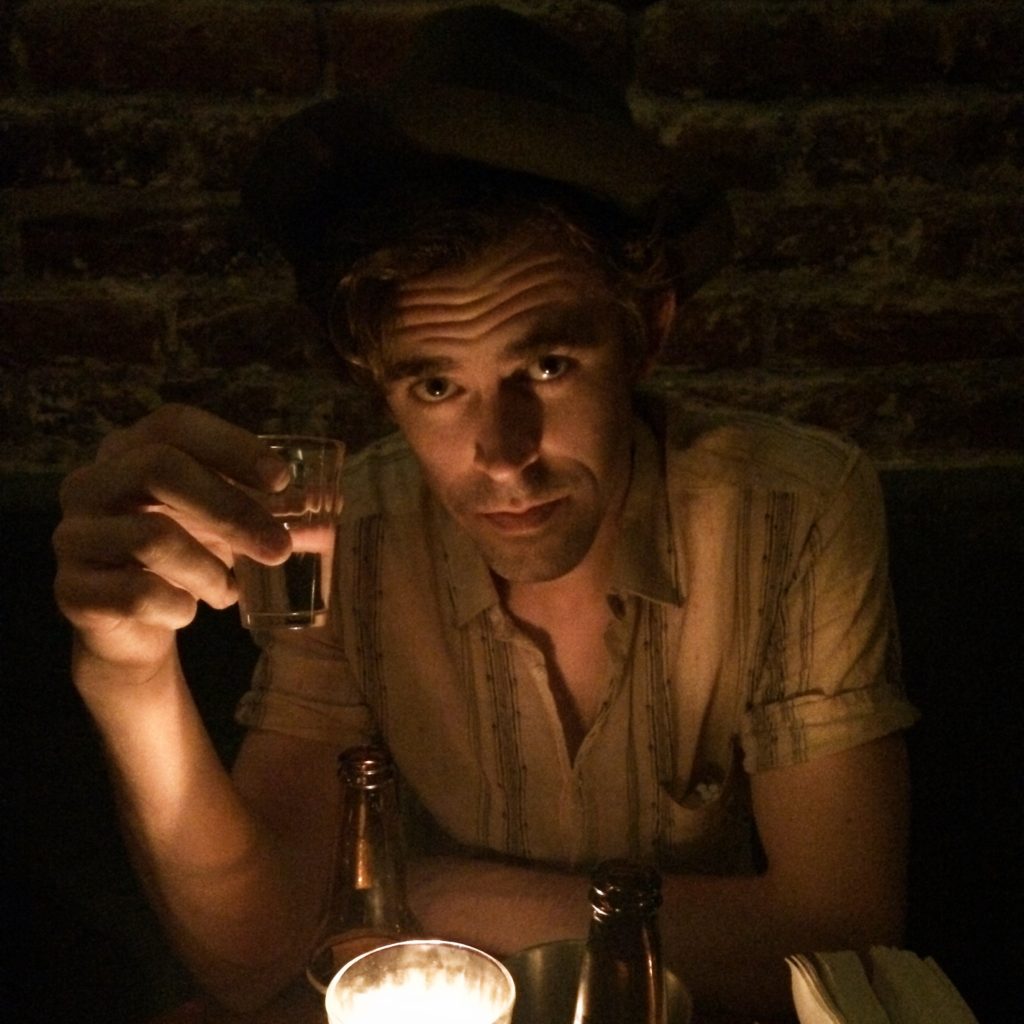
Sam Doores partaking of mezcal and beer at La Clandestina.
Two glasses and we made for home, stopping on the way back to the hostel for an order of the classic anytime-in-the-day snack of chocolate con churros—sugary branches of fried dough and a thick cup of hot chocolate for dipping. As in Spain, these can be eaten for breakfast, an afternoon snack, or a final treat before retiring.
We had a plan for the next day. We were going to take in the temples. We were going to visit Diego and Frida. And we were going to see the bullfights. It was a lot and we would need to be up before dawn. You can plan these kinds of days and have everything fall apart. Or, like it did for us, everything can line up and give you a perfect day of travel.
* * *
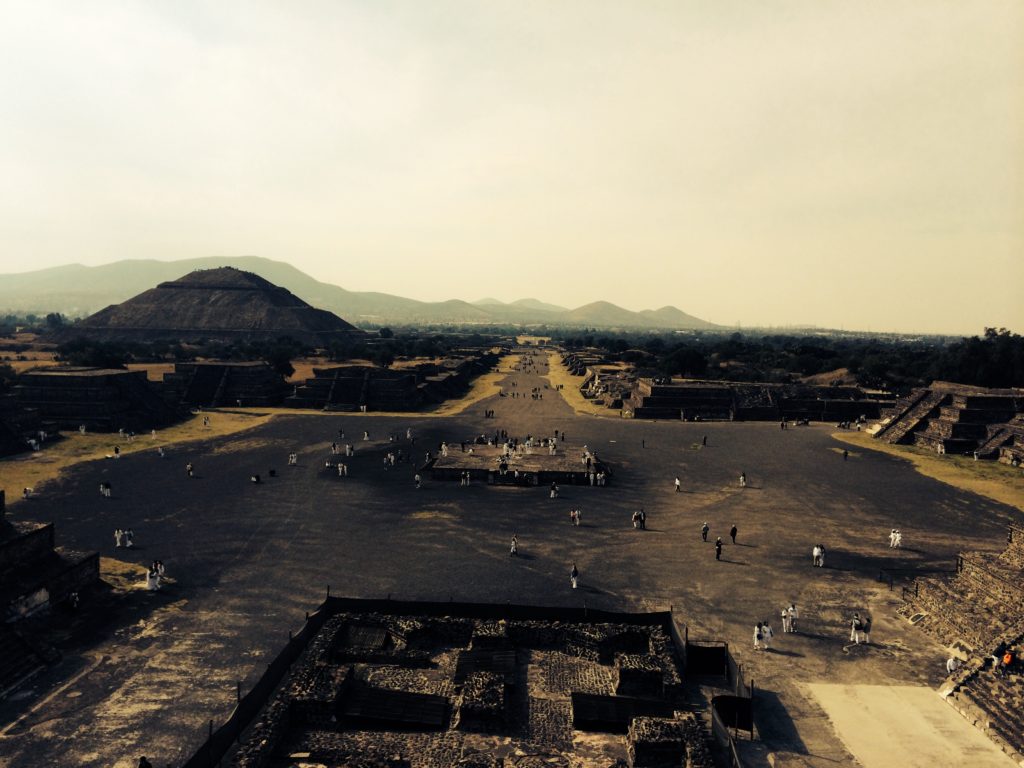
View of Teotihuacan from the Temple of the Moon.
The bus ride to Teotihuacan takes about an hour from Terminal Autobuses del Norte. Be certain you get on a bus that reads Piramides (the one that just reads Teotihuacan can leave you a good distance from the temples), and go ahead and get a round trip ticket to save yourself the hassle on the way back. I’d taken the advice of several travelers to get to the temples first thing in the morning before the crowds descended. You will hear this a lot. In my experience, it wasn’t really necessary. The temples actually felt more comfortable once people arrived. This was once a thriving city, and seeing people wandering through it, as though the markets were still alive, seemed more appropriate than standing on a deserted relic.
There are two main temples: The Temple of the Sun 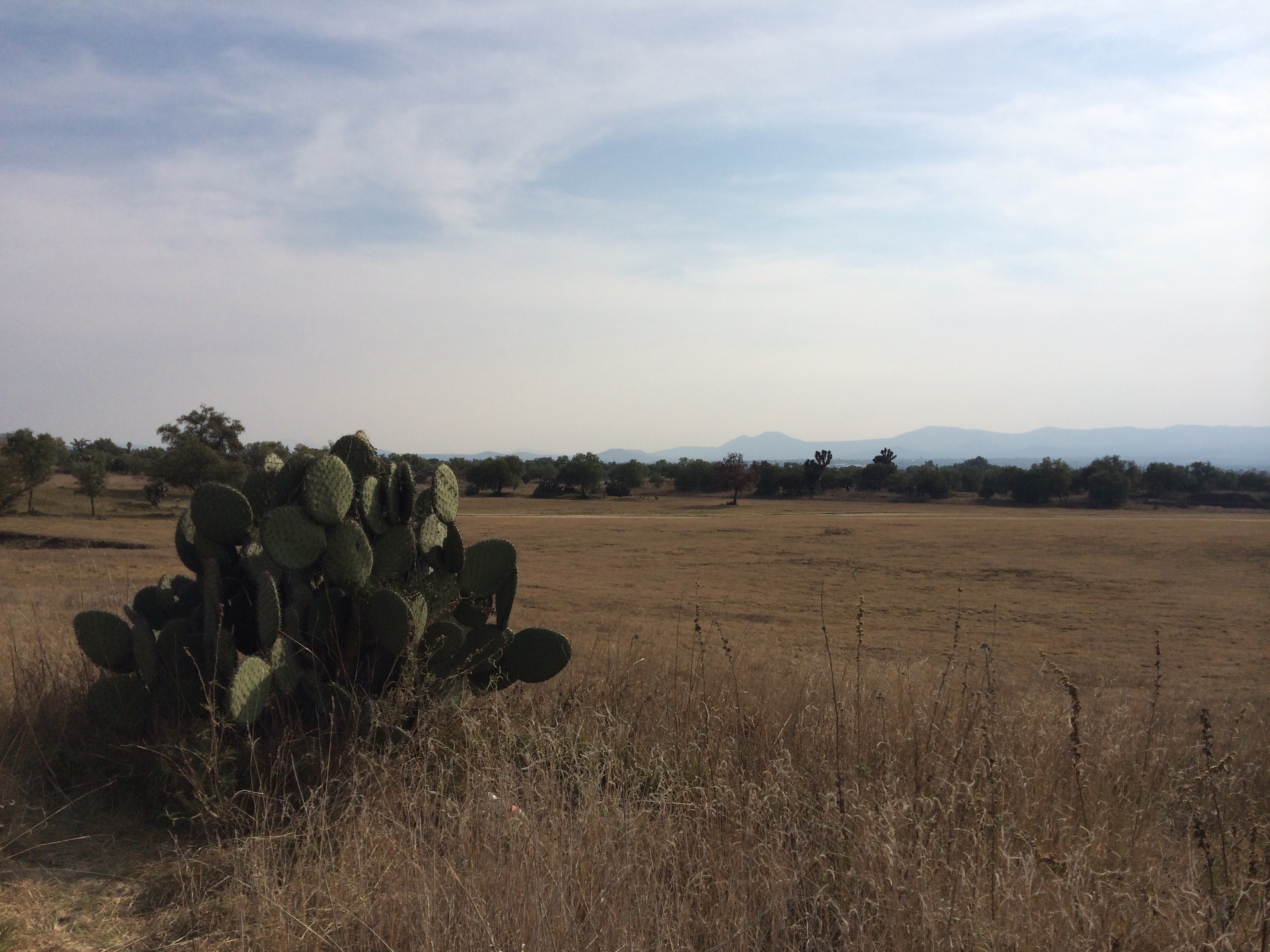 and the Temple of the Moon. We climbed the Temple of the Sun first, and it’s steep going. If I could see one reason for going early, it would be to avoid taking the steps during the midday heat, or getting stuck behind someone who can’t clamber up the last few yards. The view from the top, as you would expect, is pretty remarkable. To those who stood atop it, it must have seemed that the whole world converged here.
The road that connects the two pyramids is known as the Avenue of the Dead, and it is framed by smaller temples, which are in turn framed by wide open plains. We poured out some mezcal on those plains, then climbed the Temple of the Moon to finish the flask, eat our oranges, and sit on the temple’s stone steps and gaze out over what was once the largest city in the Americas—a moment at the center of the world, even if it’s a world that has long since gone.
* * *
Our hostel, Hostal Cujia Coyoacan, is a friendly and affordable joint with three distinctive features: a sculpture of a gecko climbing the outside wall, a rooftop terrace perfect for relaxing in the evenings, and close proximity to La Casa Azul, the longtime home of Frida Kahlo—now a museum dedicated to her and her extraordinary artwork.
Unfortunately, this place can get long in the lines. By the time Sam and I arrived, a tour group had pulled up, forming a line that snaked around the block. We took our leave and made for the Coyoacan market for lunch.
There’s something special about the markets in Mexico City. You can find almost anything you want, but you’re going to have to squeeze past people down narrow aisles and, in my case, past a brass band consisting of a bass drum, a trumpet and a tuba, slowly weaving through the market and providing a soundtrack. At the lunch counter, we ordered goat stew, and the proud proprietors pulled out their phones to show us pictures of the goat we were eating at that very moment.
With Frida’s home out of the running,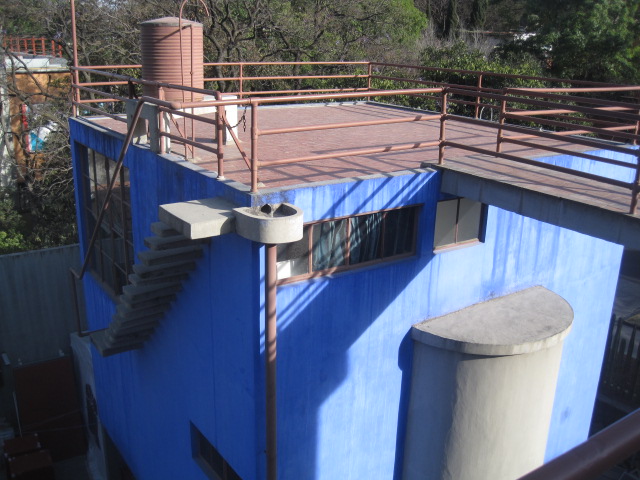 we made our way to the home she shared with the tempestuous painter Diego Rivera. The house, designed by Juan O’Gorman, is a wonder of modern architecture, from its tall cactus “fence,” to the bridge connecting the two living spaces, to the staircase that runs down the side of one of the houses like a fire escape. Although it is billed as being the home of both Rivera and Kahlo, Frida lived here for only six months. It’s really Rivera’s space, and his studio and living quarters still exist not too differently from how he left them upon his death in 1957.
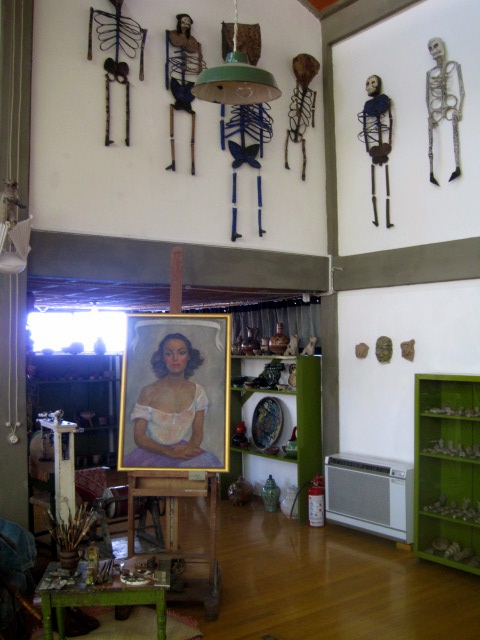
Portrait of Delores del Rio in Diego Rivera’s studio.
I’ve been in love with Diego Rivera’s work for many years. I will never forget the breathtaking experience of seeing his massive murals in the Detroit Institute of Arts for the first time. Looking at his murals is like looking into the entire history of the Americas. The canvas seems to extend forever, and the painting’s story extends along with it. He is remembered for this, but some of his finest works are simple, intimate character studies. I once saw a painting of his of a little girl on the Day of the Dead, dressed into the colors of the Mexican flag and holding a mask whose eyes glowed yellow, and was frozen to the spot for ten minutes. Great art will do that to me. I walk by a hundred paintings and then one grabs me. I stand there, terrified, or laughing, or in tears. And afterward, I fail to communicate why.
* * *
I attended my first bullfight in Spain a decade ago. I went in, like most newcomers, not knowing what to expect. It is a confusing thing to behold, as the crowds react to variety of details that are completely lost on the first time viewer. Two things surprised me at that first bullfight. The first was the amount of blood—far more than I expected. The second was how much I enjoyed the spectacle (one of the bulls even survived, as the matador performed poorly and was booed into submission before the kill). I warned Sam of the violence of the event, which he expected. He did not expect to want to see a second bullfight, but he did want to see one in his lifetime.
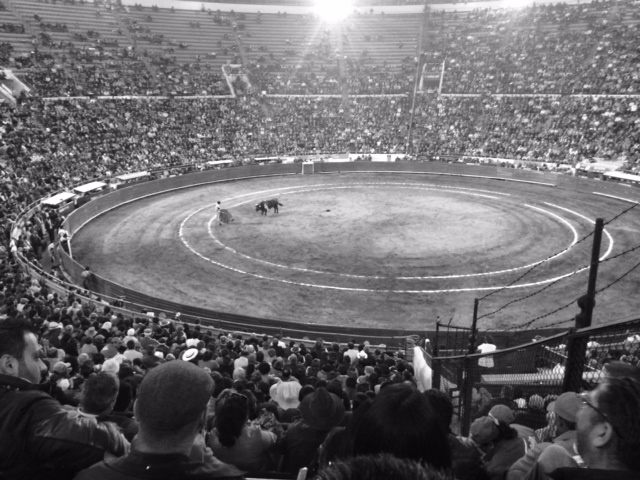
Looking down into the Plaza de Toros Mexico, the world’s largest bullfighting ring.
Mexico City’s Plaza de Toros Mexico is the largest bullfighting ring in the world, with seating capacity for over 40,000 spectators. Being inside is a powerful thing, with the seats seeming to pour down into the ring and giving you, always, a sense of being right on top of the action whether you like it or not. The details I remembered from my first fight came back in pieces. The bandilleros, who plant a series of small barbed sticks into the bull’s back. They do this on foot, with the bull giving chase as they attempt to evade its horns. The picador, who from horseback uses a lance to stab the bull in the shoulder muscles, weakening the animal but not killing it. And the matador, the master of the ring, who engages in a ferocious choreography with the bull, turning it with the cape, weakening it slowly until it is time for the final estocada, where the matador drives a sword between the bull’s shoulder muscles and pierces its heart. As strange as it is to conceive of, the desire of both the matador and the crowd is to see the bull suffer as little as possible at the end. The matadors risk injury, even death. But if they fail to kill the bull swiftly and prolong its suffering, they will be booed mercilessly. If you are going to engage in a sport centered around death, it seems to be agreed, you should be able to dispatch that death quickly.
The quality of the matadors in Mexico City tends to be very high. This is the winter headquarters for many of Spain’s finest, not to mention Mexico’s, and that quality was evident from the first fight, when the matador performed his entire routine from horseback, swiftly turning the horse away from the horns and leaning out of the saddle to perform his turns. It was extraordinary to watch, but nothing prepared us for the third fight, which left the crowd in tears.
You may know nothing about bullfighting. You may despise its very existence. I count myself among the ignorant and I am firmly against certain aspects of the spectacle (I would see the running of the bulls in Pamplona done away with tomorrow, for example). But sometimes you see an artist in their natural habitat, performing an act in which they step outside of themselves and become an embodiment of what their particular craft is about. One needed no knowledge whatsoever of the art of the fight or its history to know they were witnessing something special. Time and again, the matador passed the bull, the horns so close to his body I was certain he’d been gored. The crowd rose in frenetic shouts of “Ole! Ole!” Each one growing louder and louder, then turning into waves of applause as he performed the final pass of the series and turned away. The man next to us, clearly a fanatic supporter of the fights, began shaking. People around us were in tears. When the time came for the kill, it was flawless. The sword went in clean, the matador right over the horns as he thrust it in to the hilt, then turning away as the bull wobbled on its legs and collapsed. We had watched a man risk his life for this crowd, and it was impossible not to applaud.
I applauded. I shouted. And I am certain, at that moment, I would have utterly failed to communicate why.
* * *
With only a few hours left in the city, we returned to Coyoacan, strolling through the crowd in the main plaza and grabbing a few pastries at a wonderful shop called Pan Napoles before returning to the quiet of the hostel roof. My flight out was early in the morning, and Sam had plans to stay for an extra week. We took the remains of the mezcal up to the rooftop terrace, and with the sounds and lights of the city around us, we drank to the neighborhood, to the bulls, to the matadors, and to the day—a single day in which we had managed to take in an ancient sport, an ancient city, the work and home of a favorite artist, and ate and drank like kings the whole way through.
This city is a country unto itself. Each piece a new city, a new slice of the nation. You can look down from anywhere here and feel worlds, even epochs, converging. Looking across the Mexico City from that roof, it seemed we were standing at the very center of all things. That we were at the very capital of the world.
* * *
Los Danzantes is located on the edge of Plaza Jardin Centenario in central Coyoacan. They are open seven days a week and have a website here.
The Palacio de Bellas Artes is located in the Centro Historico next to the Bellas Artes Metro stop. It is open from 10 a.m. to 5 p.m., Tuesday through Sunday. Their website is here.
La CLandestina sits at Alvaro Obregon 298 in the Condesa neighborhood. Look for the agave painted on the outside. They don’t have a website because of course they don’t.
La Casa Azul is at Londres 247, at the intersection with Ignacio Allende. It is open from 10 a.m. to 5:30 p.m., Tuesday through Sunday. There is an extra charge for photographs. Get Frida’s Mole Poblano recipe. It’s written on the kitchen wall. Website is here.
The Diego Rivera house and museum (Museo Casa Estudio Deigo Rivera y Frida Kahlo) is located at the corner of Calle Diego Rivera and Altavista in the San Angel neighborhood. Their website is here.
Plaza de Toros Mexico is located at Calle Augusto Rodin 241, next to the Estadio Azul soccer stadium. Bullfighting season runs from November to March.
Hostal Cujia Coyoacan is located at Berlin 268. Look for the big gecko on the outside. Their website is here.
0 comment
I love your writing, Nick! El D.F. Is one of my favorite cities in the world and you’ve captured it so perfectly.